

Results
Throughout the project, ENACT will produce several reports, outcomes and products that aim to give back the knowledge generated to the FCT community. Where these results can be made public, they are shared below. You can also check out all of our reports on our Zenodo Community.
Flash Reports
ENACT produces on-demand flash reports relevant to the FCT community. Read these reports below.
1st ENACT Flash Report – Security Market Overview: Trends & Insights from the SICUR Exhibition
Read the report: Security Market Overview: Trends & Insights from the SICUR Exhibition
This first Flash Report provides an overview of the Salón Internacional de la Seguridad (SICUR) international exhibition for Security in Spain. The fair, which takes place every two years, brings together companies, associations, professionals and users of global security in the public and private spheres in Madrid.
This report maps the exhibitors at SICUR to the technology domain, policy domain and the FCT functions of the EU Security Market Taxonomy. The main analysis shows that cybersecurity was widely addressed at the conference, showing the high interest of the security community in the protection of information systems. Furthermore, the high interest shown during SICUR for protection against CBRN incidents and for personal and other equipment also indicates the importance given by the community for the safety and protection of LEA first responders.
Download the accompanying Appendix
We’re collecting feedback on this report through the EU Survey Platform, if you’d like to share your thoughts please click on the link below.
2nd ENACT Flash Report – Security Market Overview: TECHNOSEC & DRONExpo Event
Read the report: Security Market Overview: TECNOSEC & DRONExpo Event
This second Flash Report provides an overview of the TECNOSEC and DRONExpo events in Spain. TECNOSEC is the premier professional forum for police, intelligence and security technologies. TECNOSEC serves as a focal point for major security stakeholders by facilitating the exchange of knowledge and trends, presenting practical works and products tailored for security and intelligence bodies and critical infrastructures.
This report maps the exhibitors at TECNOSEC and DRONExpo to the technology domain, policy domain and the FCT functions of the EU Security Market Taxonomy. The main analysis shows that monitoring and surveillance technologies were particularly prominent amongst the exhibitors. Meanwhile, the conference sessions at the event showed a clear focus in the areas of mobility and deployability, as well as secure and public communication, data and information exchange functions.
Download the accompanying Appendix
We’re collecting feedback on this report through the EU Survey Platform, if you’d like to share your thoughts please click on the link below.
3rd ENACT Flash Report – EUROSATORY 2024 Security & Defence Event
Read the report: EUROSATORY 2024 Security & Defence Event
This third ENACT Flash Report provides an overview of the EUROSATORY Security and Defence event that took place in June 2024 in Paris. EUROSATORY is the global land and air benchmark event for Defence and Security professionals gathering over 2,000 exhibitors from 61 countries, 120 conferences and over 40,000 visitors. The event is organised by the Group of French Industries for Land and Air-Land Defence and Security (GICAT), an association gathering more than 300 large groups, small-medium enterprises (SMEs) and start-ups.
Similarly to other security events, such as SICUR, TECNOSEC and DRONEXPO, which ENACT actively tracks to produce flash reports, the scale of the EUROSATORY event fosters worldwide cooperation and attracts significant investments from governments and industries. This report discusses how the event offers a platform for smaller businesses and research centres to showcase innovative solutions and underscores Europe’s leadership in security innovation, addressing both European and global D&S needs.
We’re collecting feedback on this report through the EU Survey Platform, if you’d like to share your thoughts please click on the link below.
4th ENACT Flash Report – Drug production, distribution, and forensics research in Horizon 2020 and Horizon Europe
Read the report: Drug Production, distribution, and forensics research in Horizon 2020 and Horizon Europe
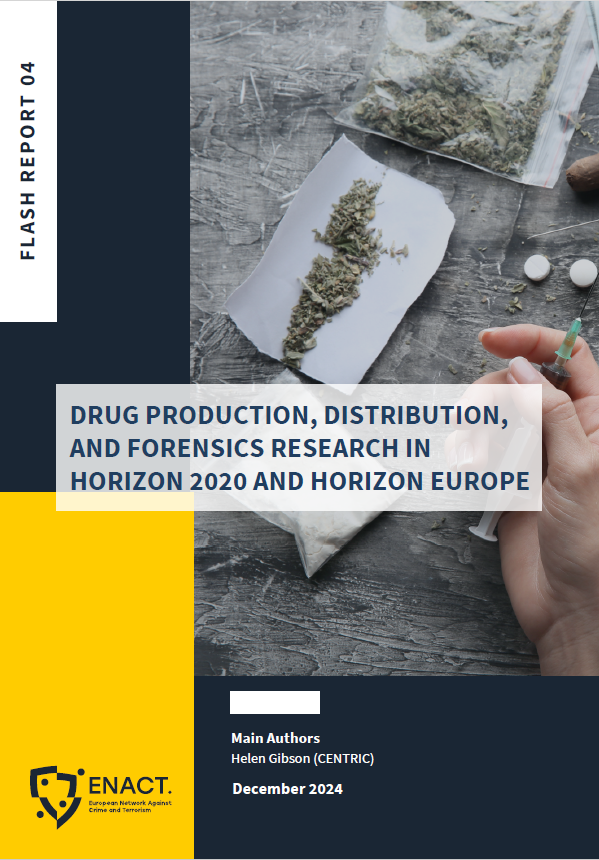
This 4th ENACT Flash Report was commissioned by the European Union Drugs Agency (EUDA), formerly known as the European Monitoring Centre for Drugs and Drug Addiction (EMCDDA) until July 2024. The transition from EMCDDA to EUDA signifies an enhanced mandate to address emerging health and security challenges associated with illicit drugs.
This report emphasises the second focus area, structured around three key pillars: drug production, drug distribution, and drug forensics. It specifically highlights research projects funded under the European research programmes Horizon 2020 and Horizon Europe that concentrate on these critical domains.
We’re collecting feedback on this report through the EU Survey Platform, if you’d like to share your thoughts please click on the link below.
5th ENACT Flash Report – Addressing the challenges of missing persons
Read the report: Addressing the challenges of missing persons
This report was commissioned by the European Commission’s Directorate-General for Migration and Home Affairs, and its community for a European Research and Innovation for Security (CERIS) workshop aimed at discussing Missing Persons that took place on March 19th, 2025.
To compose this report, ENACT ENACT leveraged its Structured Knowledge Base to map ongoing research projects on missing persons, some well-known technologies for cases investigation (DNA forensics, OSINT..) and underline the critical need for stronger prevention strategies and statistical tools since each year, an estimated 300,000 to 600,000 individuals are reported missing in Europe.
We’re collecting feedback on this report through the EU Survey Platform, if you’d like to share your thoughts please click on the link below.
6th ENACT Flash Report – Home Office Security & Policing Event 2025
Read the report: Home Office Security and Policing Event 2025

This report details the Home Office Security & Policing (S&P) 2025 exhibition that took place in Farnborough, UK from 11-13 March. The report discusses how S&P has reinforced its position as a premier event for security professionals, with the 2025 event bringing together over 430 exhibitors from 25 countries and more than 9,600 visitors. This closed-door event, organised by the UK Home Office and key partners, offers a unique and trusted environment for confidential discussions on sensitive technologies, operational needs, and future security priorities—something public trade shows can’t match.
ENACT’s review of S&P 2025 revealed key insights into the evolving security landscape, observing a notable increase in overlapping areas of interest, such as the strong links between human/goods trafficking, cargo crime, and community policing, or public space protection with advanced technologies like encryption and 5G. S&P 2025 proved to be a critical interface where future-ready technologies meet national and international security priorities, offering an exclusive platform for researchers, innovators, and manufacturers to engage directly with strategic buyers and decision-makers.
We’re collecting feedback on this report through the EU Survey Platform, if you’d like to share your thoughts please click on the link below.
7th ENACT Flash Report – Youth and Criminality
Read the report: Youth and Criminality

This report was commissioned by the European Commission’s Directorate-General for Migration and Home Affairs, and its community for the Annual CERIS Fight against Crime and Terrorism event focusing on youth-related criminality and training for practitioners held on 30 September – 1 October 2025.
Youth are implicated in, and disproportionately affected by, a broadening range of criminal phenomena: traditional offences (violent incidents, knife crime), drug-related offending (including darknet markets and party-drugs contexts), online harms (cybercrime, grooming, radicalisation) and exploitation (trafficking, social-media-facilitated recruitment). New vectors, such as social platforms, the ‘manosphere’, AI tools and gamified learning environments, are changing both how youth are recruited into crime and how they are victimised. Prevention that focuses on early intervention, parental and school support, place-based community responses, and targeted digital resilience yields the strongest evidence of reducing both perpetration and victimisation.
We’re collecting feedback on this report, please leave your thoughts and comments anonymously through the following survey:
8th ENACT Flash Report – Digital Tools for Online Crime Monitoring: Investigative Technologies Supporting Law Enforcement Agencies
Read the report: Digital Tools for Online Crime Monitoring: Investigative Technologies Supporting Law Enforcement Agencies
This report was requested by the AHEAD project. AHEAD is an EU-funded project that aims to design and operationalise a sustainable capability-based civil security foresight framework which generates evidenced-based capability roadmaps.
The aim of this report was to provide an overview of the current state of tools and approaches for different forms of online crime investigation. The report considers the use of web crawling, adaptive monitoring and autonomous agents. While the potential role of digital twins and honeypots are also introduced. The report also presents the policy, legal and ethical view, presents key developments in EU-funded projects under this area whilst utilising the analysis of the relevant observations from the ENACT structured knowledge base.
We’re collecting feedback on this report, please leave your thoughts and comments anonymously through the following survey: https://ec.europa.eu/eusurvey/runner/enact-report-feedback
9th ENACT Flash Report – AI Act and Law Enforcement
Read the report: AI Act and Law Enforcement

The EU AI Act is already shaping how Law Enforcement can use and apply artificial intelligence (AI) in a variety of situations. This timely report from ENACT, brings together relevant discourse from the ENACT SKB to provide insights on the impact on law enforcement in various ares.
The report covers the technology view, including the potential impact on research and development in the FCT area; the markets and standards view; and the legal, ethical, and societal view alongside relevant observations from the SKB.
We’re collecting feedback on this report, please leave your thoughts and comments anonymously through the following survey:
11th ENACT Flash Report – Web Traps and Digital Resilience: Leveraging Serious Educational Games for Child Safety
Read the report: Web Traps and Digital Resilience
This report was requested by the AHEAD project. AHEAD is an EU-funded project that aims to design and operationalise a sustainable capability-based civil security foresight framework which generates evidenced-based capability roadmaps.
The ubiquitous integration of the Internet in daily life has created both opportunities and risks, particularly for younger users who often lack awareness of the dangers associated with unregulated digital activity. As a result, children are somewhat susceptible to web traps—malicious tactics designed to exploit personal data, financial resources or psychological vulnerabilities. These threats include, but are not limited to, phishing schemes, grooming, radicalisation pathways, and social engineering tactics, all of which endanger young individuals in online environments.
This Flash Report analyses the key entries in the ENACT knowledge base relating to web traps and digital resilience for children, and categorises a wide array of serious games designed to educate children and their guardians in making safe decisions in the online space.
We’re collecting feedback on this report, please leave your thoughts and comments anonymously through the following survey:
12th ENACT Flash Report – Europol Industry and Research Days
Read the report: Europol Industry and Research Days
This report was prepared in collaboration with the Europol Innovation Lab who organise the Industry and Research days at the start of each year.
Organised by the Europol Innovation Lab, the Europol Industry and Research Days, running annually in The Hague, the Netherlands, is described by Europol as a key platform to foster collaboration, innovation and knowledge exchange among law-enforcement agencies, industry and research.
This Flash Report provides an overview of the Industry & Research Days concept, a review and classification of the organisations invited to demonstrate their solutions in the February 2025 edition, according to the EU Civil Security Taxonomy. The key areas that dominated the 2025 were AI-based analytics, unmanned systems, deepfake detection, advanced biometrics, OSINT in private channels, and cryptocurrencies, financial intelligence and cybersecurity. The report concludes by looking forward to the 2026 edition, scheduled for the end of February 2026.
We’re collecting feedback on this report, please leave your thoughts and comments anonymously through the following survey: https://ec.europa.eu/eusurvey/runner/enact-report-feedback
Special Flash Report – Horizon Europe Cluster 3 2026 – FCT Factsheet (FR16)
Read the report: ENACT CL3 FCT 2026 Factsheet
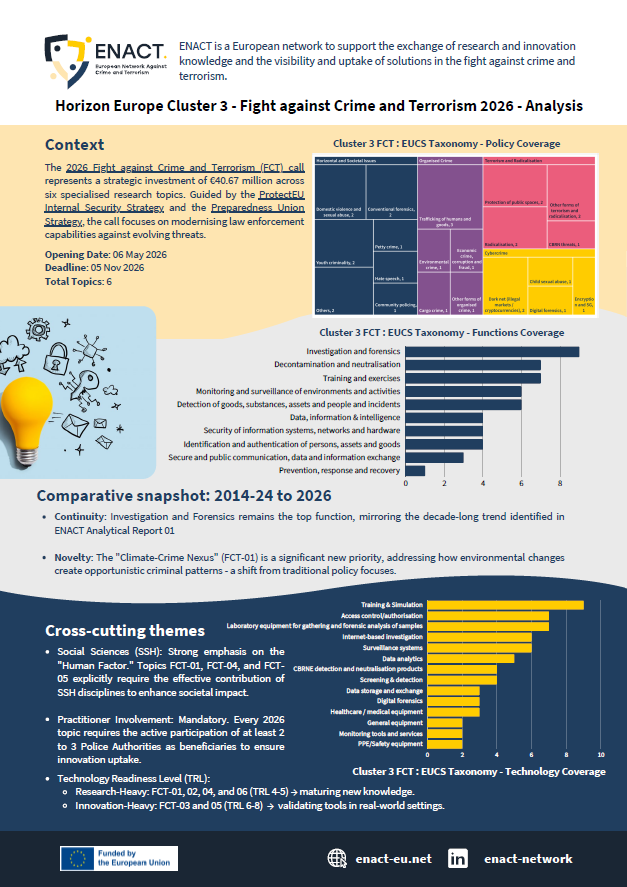
This Factsheet provide a concise and at-a-glance overview of the FCT call topics under Cluster 3 for 2026. Each of topics has been classified according to the policy, functions and technology areas of the EU Civil Security Taxonomy, highlighting the different emphases across the programme.
The factsheet can serve as a reference point for both experienced participants and new entrants looking to align their products and services to each of the call topics, serving as a basis to initiate or join consortia for the upcoming calls.
We’re collecting feedback on this report, please leave your thoughts and comments anonymously through the following survey: https://ec.europa.eu/eusurvey/runner/enact-report-feedback
15th Flash Report – Strengthening LEA Capabilities: EU-funded Innovation Procurement in Public Order and Substance Detection
Read the report: Strengthening LEA Capabilities: EU-funded Innovation Procurement in Public Order and Substance Detection
Law Enforcement Agencies (LEAs) across Europe face increasingly complex challenges in safeguarding public order and security. Rapid technological change, the rise of new forms of crime, and heightened expectations from citizens demand innovative solutions that go beyond traditional procurement practices. Innovation procurement offers a structured pathway for public authorities to stimulate the development and adoption of cutting-edge technologies while ensuring compliance with legal frameworks and respect for ethical standards. By leveraging instruments such as Coordination and Support Actions (CSA), Pre-Commercial Procurement (PCP), and Public Procurement of Innovative Solutions (PPI), authorities can move from capacity building to prototype testing and ultimately to large-scale deployment. This report focuses on two thematic areas of particular relevance to law enforcement: AI-based monitoring of public order and security, and portable air scanning techniques for detecting unauthorised substances. It aims to provide a foundation for initiating innovation procurement in these domains, addressing legal, technical, and ethical aspects, and exploring the potential for a coordinated European effort under initiatives such as the Europol Innovation Lab.
We’re collecting feedback on this report, please leave your thoughts and comments anonymously through the following survey: https://ec.europa.eu/eusurvey/runner/enact-report-feedback
18th Flash Report – Who’s who? Navigating the FCT R&I Stakeholder Ecosystem
Read the report: Who’s who? Navigating the FCT R&I stakeholder ecosystem
To understand the dynamics of the EU-funded FCT R&I cycle, it is important to know what the different stages of programming and implementation are. From the initial consultations, through the different drafts, and until the final adoption and implementation of the Work Programmes, different stakeholders intervene and contribute with different roles.
In this report, we present and review the following roles that contribute to the overall FCT R&I stakeholder ecosystem.
- Programming and implementation: Entities with the formal mandate to draft and adopt strategic plans and Work Programmes outlining priorities, funding opportunities, and timelines; to carry out budgetary control and manage the project proposal evaluation process; to monitor project performance; and to evaluate the overall impact of the programme.
- Contribution: Entities with a mandate to support the Commission in the programming and implementation of programmes by providing subject matter expertise.
- Advisory: Entities without a formal mandate to contribute to programming, but which provide input, either on their own initiative or upon request by the Commission, based on their subject matter knowledge.
- Participation: Entities that are beneficiaries of EU funding under the Horizon Europe programme.
We’re collecting feedback on this report, please leave your thoughts and comments anonymously through the following survey: https://ec.europa.eu/eusurvey/runner/enact-report-feedback
20th Flash Report – AI and implications on victims
Read the report: AI and implications on victims
Nowadays, the real gap is not just what AI can do, but what victims actually need versus what systems provide: current versus emerging victim needs. The biggest shift is that victims are no longer only harmed by individuals or institutions, but by complex socio-technical systems where responsibility is diffuse, harm is scalable and visibility is low. Classifying victims of AI involves identifying who is harmed, the nature of the harm and the method of victimisation. Based on current AI incident taxonomies and real-world incidents, AI victims can be classified across several dimensions, including individuals, groups and society at large.
This report aims to reflect on and refocus the issue of AI within the context of victims, exploring the different aspects related to the relationship between victims and AI systems across multiple dimensions, effectively examining how AI:
- shapes victimisation, i.e., how harm is produced and scaled,
- affects recognition and response, including technology and operational aspects,
- redistributes risks and responsibilities, including market dynamics, and
- challenges accountability and rights, in relation to European legal and ethical frameworks.
This report was requested by the International Network Supporting Victims of Terrorism and Mass Violence (INVICTIM) to support the 2026 INVICTIM Symposium, which has the theme Reimagining Victim Support in a Changing World: Learning from the Past, Succeeding in the Present, Preparing for the Future.
We’re collecting feedback on this report, please leave your thoughts and comments anonymously through the following survey: https://ec.europa.eu/eusurvey/runner/enact-report-feedback
23rd Flash Report – Counter-UAS capabilities in the EU
Read the report: Counter UAS capabilities in the EU
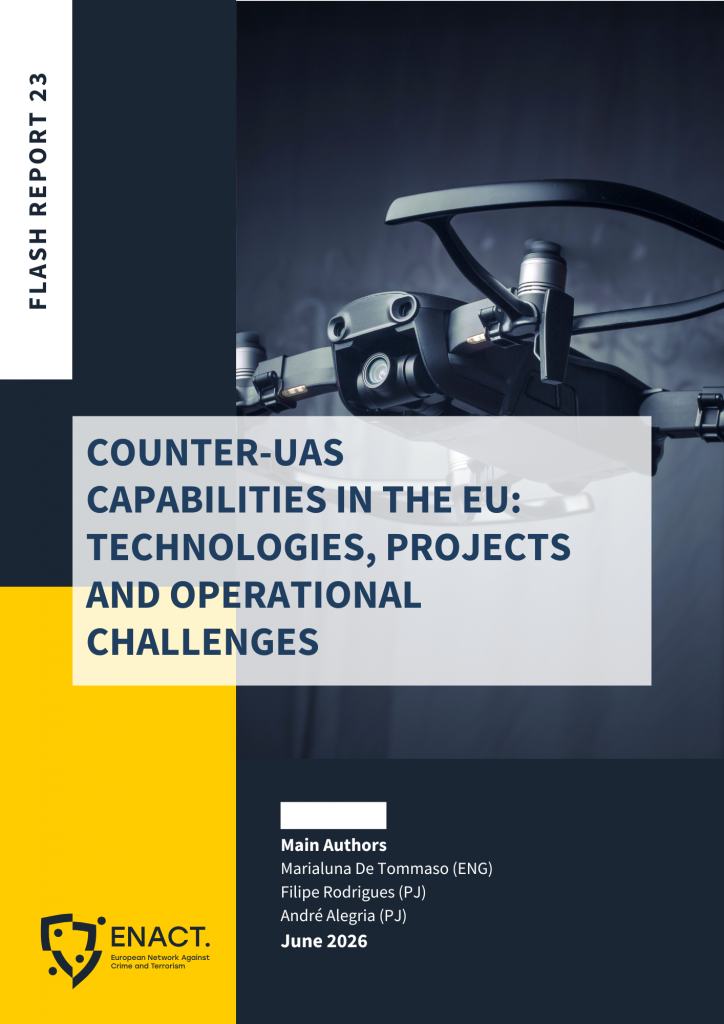
The growth of unmanned aerial systems (UAS) is reshaping European security, blurring defence and internal security lines. While drones benefit law enforcement, civil protection, emergency response, border surveillance, and infrastructure monitoring, misuse by criminals and terrorists creates operational risks for European Law Enforcement Agencies (LEAs). Counter-UAS (C-UAS) capabilities have become a strategic priority at the EU and Member State levels, with recent policies emphasising the importance of integrating security and defence efforts, industry, research, and operational learning.
This ENACT report assesses Europe’s current C-UAS capabilities, exploring the complex threat landscape, including autonomous, RF-silent, and GNSS-denied drones, and the operational, technological, and cooperation models supporting capability development. Effective C-UAS relies on integrating detection, tracking, identification, situational awareness, decision-making, mitigation, and forensic measures within a legal and procedural framework supported by trained personnel and interoperable tools. Challenges include detection in complex environments, system interoperability, lawful mitigation, cross-border coordination, and emerging threats like autonomous and RF-silent drones, including fibre-optic FPV drones. For LEAs and European security, C-UAS is crucial for countering crime and terrorism in technologically advanced contexts. Future efforts should focus on operational concepts, security-defence collaboration, layered architectures, testing, legal clarity, and translating research into deployable capabilities.
We’re collecting feedback on this report, please leave your thoughts and comments anonymously through the following survey: https://ec.europa.eu/eusurvey/runner/enact-report-feedback
This report was requested by PRESERVE Protecting euRopean public spaces against Emergent hoStile drone thrEats thRough an adVanced multidimensional shield and cross-border intelligEnce). We are grateful for the request, engagement and feedback throughout the development of the report. PRESERVE brings together 16 partners, including four LEAs, to tackle the so far threat of weaponised recreational/consumer drone swarms through open-source knowledge by non-state actors. .
26th Flash Report – Law enforcement’s role in countering hybrid threats
Read the report: Law enforcement’s role in countering hybrid threats
Hybrid threats represent one of the defining security challenges facing the EU and its partners in the 21st century. Their ability to operate below the threshold of armed conflict, exploit democratic vulnerabilities and combine multiple instruments of power simultaneously makes them particularly difficult to detect, attribute and counter. Unlike traditional security threats, hybrid threats deliberately blur the boundaries between war and peace, civilian and military domains, and internal and external security.
This report considers how LEAs are in an increasingly central position within broader national and European security architectures, and thus how they have an increasingly important role in countering and responding to hybrid threats. The report significantly notes there are several common themes to be addressed within this space, such as
- The need to move towards common definitions, situational awareness, and strategic coordination across institutions to mitigate against operational siloes that can be exploited by hybrid threats.
- Focus on building resilience and institutional capacity within law enforcement to improve early warning systems and public awareness.
- Foresight and forward planning within law enforcement are essential to anticipate vulnerabilities and hybrid threats at an early stage.
- Enlist whole-of-government and whole-of-society responses to motivate cooperation across public and private actors in the domain.
We’re collecting feedback on this report, please leave your thoughts and comments anonymously through the following survey: https://ec.europa.eu/eusurvey/runner/enact-report-feedback
This report was requested by CEPOL, the European Union Agency for Law Enforcement Training, as a complementary report to their 2026 Research Week, which this year was focused on tackling hybrid threats. We thank CEPOL for their engagement and valuable feedback during the report preparation process.
Country Profiles
As part of the Flash Reports, ENACT has prepared a dedicated series of country profiles – an overview of how selected EU MS appear in the ENACT stakeholders map, and their involvement in the Horizon Europe Cluster 3 Destination on the Fight against Crime and Terrorism.
ENACT Country Profile: Spain (ENACT Flash Report 10)
Read the report: ENACT Country Profile: Spain
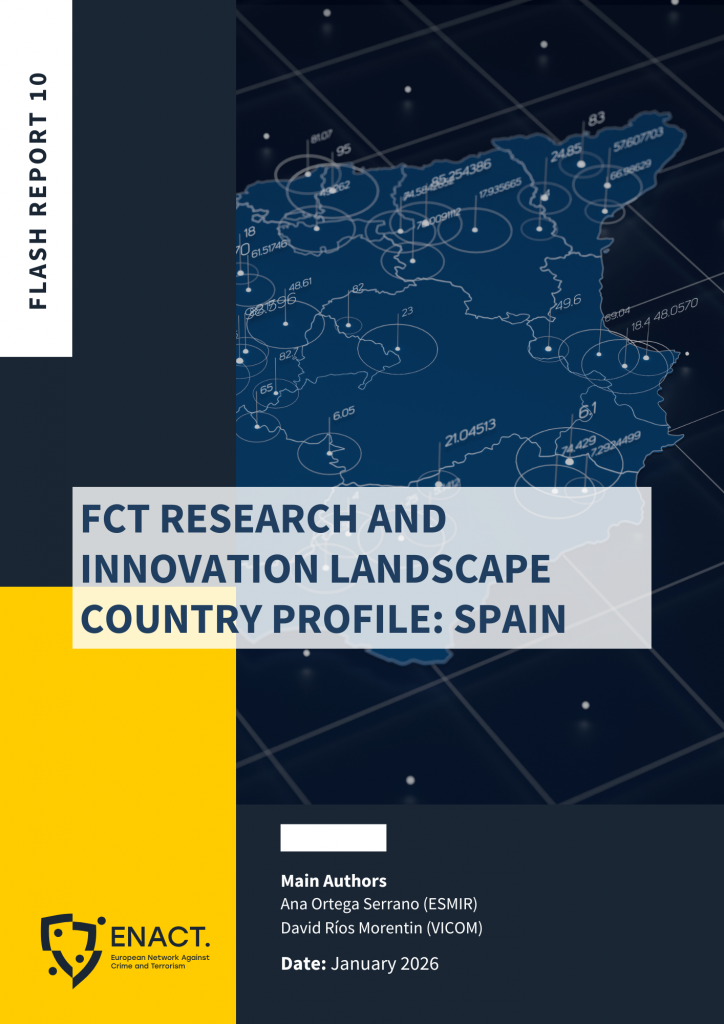
This country profile shows how Spain plays a leading role in European security research, demonstrated by strong participation, coordination, and above-average success in Horizon Europe security projects. Spanish organisations are particularly active in addressing digital and economic crime, cybercrime, and counterterrorism, with complementary strengths in investigation and forensics, intelligence and data gathering, and operational training. This activity is supported by a diverse ecosystem spanning law enforcement, academia, industry, and research centres, ensuring practical and operationally relevant outcomes. Technologically, Spain shows robust expertise in digital technologies, artificial intelligence, cybersecurity, interoperability, and sensing solutions, aligning closely with European security priorities and emerging operational needs.
We’re collecting feedback on this report through the EU Survey Platform, if you’d like to share your thoughts please click on the link below.
ENACT Country Profile: Italy (ENACT Flash Report 13)
Read the report: ENACT Country Profile: Italy
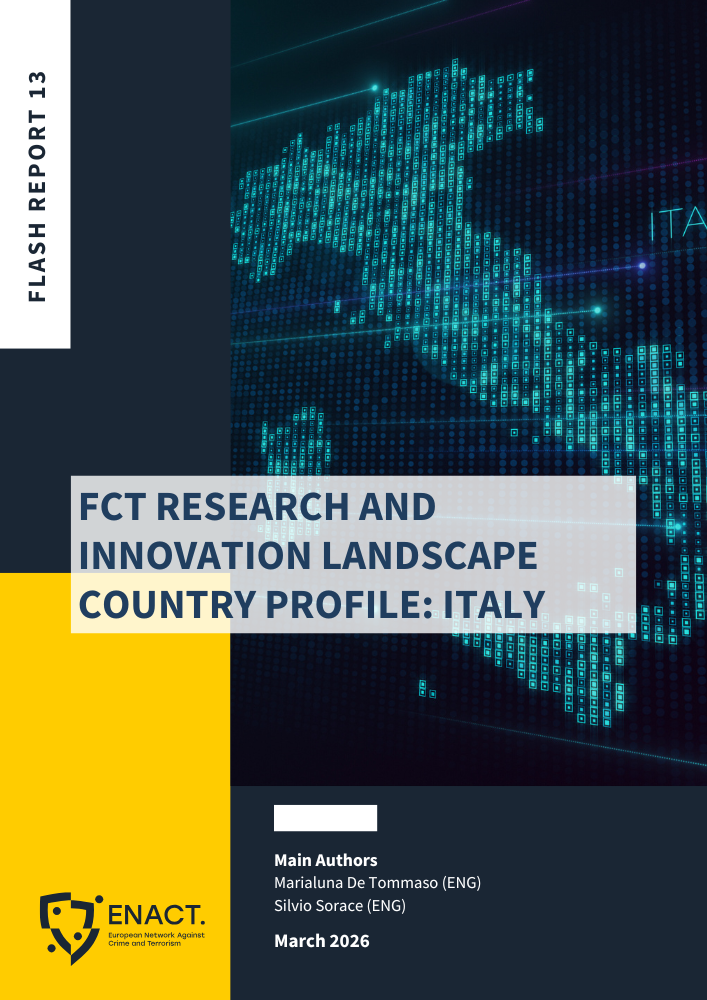
This country profile shows how Italy’s role in European security research is characterised by a high degree of efficiency and strategic leadership, evidenced by its position as one of the top recipients of Horizon Europe funding and its capacity to coordinate high-value collaborative projects. Within the policy landscape, Italian organisations are most active in tackling Economic Crime, Corruption and Fraud, alongside significant contributions to CBRN Threats and the Fight Against Cybercrime (including Dark Net and Illegal Markets).
This robust involvement is driven by a prestigious research community, comprising law enforcement agencies, world-class academic institutions, and a highly innovative SME sector, ensuring that research outcomes effectively bridge the gap between scientific excellence and operational utility.
We’re collecting feedback on this report through the EU Survey Platform, if you’d like to share your thoughts please click on the link below.
ENACT Country Profile: United Kingdom (ENACT Flash Report 14)
Read the report: ENACT Country Profile: UK
This country profile shows how, despite the United Kingdom’s (UK) exit from the European Union and subsequent delay in full association with the Horizon Europe programme, the UK has retained a significant involvement within the European FCT research and innovation landscape, demonstrating a commitment to the European research agenda and continued close cooperation in the area of security. Within Horizon Europe specifically, the UK has continued to be among the top five countries for signed grants and for overall participation by UK entities, demonstrating a strong commitment to the FCT research area in Europe.
Overall, the UK shows a diverse set of expertise across policy areas, with a large number of stakeholders contributing across the security sector. Increasing engagement from end-users, such as law enforcement agencies, also ensures a high consideration of operational needs and requirements, maximising opportunities for exploitation.
We’re collecting feedback on this report through the EU Survey Platform, if you’d like to share your thoughts please click on the link below.
ENACT Country Profile: Germany (ENACT Flash Report 17)
Read the report: ENACT Country Profile: Germany
This country profile shows how Germany’s role in European civil security research is characterised by consistent participation and solid performance within Horizon Europe CL3-FCT activities, placing the country among the leading contributors in the programme. Germany ranks fourth in both signed grants and total net EU contribution, following Greece, Spain, and Italy, and ahead of other major participants such as France and Belgium. From a policy perspective, German organisations are most strongly engaged in Cybercrime-related topics, followed by horizontal and societal issues. The highest participation is observed in Dark Net, Illegal Markets and Cryptocurrencies, and Trafficking of Humans and Goods, indicating a concentration on digitally mediated and transnational security challenges.
Overall, Germany’s participation ecosystem is primarily driven by private sector actors and higher education institutions. Nevertheless, a wider range of strengths demonstrates a mature, resilient, and innovation-oriented ecosystem, positioning Germany as a strategically influential actor shaping the direction and effectiveness of European civil security research.
We’re collecting feedback on this report through the EU Survey Platform, if you’d like to share your thoughts please click on the link below.
ENACT Country Profile: Portugal (ENACT Flash Report 19)
Read the report: ENACT Country Profile: Portugal
This country profile demonstrates how Portugal’s participation in the FCT research ecosystem under Horizon Europe showcases a competitive profile with strong proposal success, consistent project involvement, and expertise in security domains. Despite a smaller ecosystem, Portuguese organisations effectively compete with larger Member States, securing numerous projects and high success rates. Policy-wise, Portugal covers all FCT domains, emphasising Cybercrime and Organised Crime. In terms of functions, Portugal focuses on Investigation, Forensics, Data Management, Secure Communication, and Training, supporting operational and intelligence-led approaches. Technologically, it emphasises digital, data-driven solutions like Internet Investigation, Digital Forensics, and Interoperable Communication, aligning with digital security trends. Participation is concentrated among a few actors, with limited SME and private-sector involvement. Expanding industrial involvement and SME roles could boost Portugal’s impact. Overall, Portugal is a focused, competitive actor in the FCT ecosystem, combining digital security expertise with broad policy engagement and high-quality European contributions.
We’re collecting feedback on this report through the EU Survey Platform, if you’d like to share your thoughts please click on the link below.
ENACT Country Profile: Belgium (ENACT Flash Report 21)
Read the report: ENACT Country Profile: Belgium
This country profile demonstrates how Belgium’s participation in the FCT research ecosystem under Horizon Europe demonstrates a competitive and well-positioned profile, characterised by above-average proposal performance, consistent project involvement, and specialised expertise in key security domains. The country’s established and growing research ecosystem allows national entities to collaborate effectively with each other, as well as with international partners, securing a significant number of projects.
From a policy perspective, Belgium’s involvement in FCT projects covers all FCT domains, with a clear emphasis on Cybercrime, which leads to a participation strongly oriented towards Data and Intelligence Management, and Investigation and Forensics, supported by Training and Exercises. Belgium’s participation is also characterised by a strong academic profile, with significant involvement of Higher Education Entities, with private entities bringing research into practice and to the market. This combination of academic and industry profiles is well aligned with the EU ecosystem and goals of market development, which could be enhanced by greater SME participation.
We’re collecting feedback on this report through the EU Survey Platform, if you’d like to share your thoughts please click on the link below.
ENACT Country Profile: Netherlands (ENACT Flash Report 22)
Read the report: ENACT Country Profile: Netherlands
This country profile demonstrates how the Netherlands participation in the FCT research ecosystem under Horizon Europe demonstrates a strong stakeholder profile and a considered project involvement, focused on specialised areas such as cybercrime. Despite operating within a smaller national ecosystem, Dutch organisations have demonstrated the capacity and capability to compete effectively with larger Member States – notably achieving the highest success rate amongst proposal evaluations in Horizon Europe for FCT.
From a policy perspective, Belgium’s involvement in FCT projects covers all FCT domains, with a clear emphasis on Cybercrime, complemented with a strong engagement in organised crime and especially areas such as trafficking and economic crime. The Netherlands has a strong technology profile, with a focus on data-driven solutions such as internet-based investigations, data storage and exchange, digital forensics, and interoperable communication technologies. Interestingly, despite this success, contributions come from a relatively concentrated number of actors. Although there is strong engagement from across industry, there remains an opportunity to increase SME participation to allow the country to scale its contribution to the EU ecosystem.
We’re collecting feedback on this report through the EU Survey Platform, if you’d like to share your thoughts please click on the link below.
ENACT Country Profile: France (ENACT Flash Report 24)
Read the report: ENACT Country Profile: France
This country profile demonstrates how France plays a leading role in the FCT domain, ranking amongst the top beneficiaries of Horizon Europe funding, with approximately 11.4% of the total allocated budget. French stakeholders are highly engaged in cross-sector projects, frequently assuming coordination responsibilities or leading key work packages.
A distinctive feature of France’s participation is the role of the Police Nationale and Gendarmerie Nationale, two key actors in many EU-funded security projects. Their involvement ensures a strong alignment between research activities and real-world law enforcement needs, particularly in areas such as Internal Security, Crisis Management, and the Protection of Public Spaces. Furthermore, a broad ecosystem of public research institutions, governmental bodies, and industrial partners contributes to the national effort.
France’s research and innovation community is actively involved across a wide range of FCT priorities, including Artificial Intelligence, Cybersecurity, Border Management, and Digital Transformation. Beyond technological development, French actors also play a significant role in shaping regulatory frameworks and promoting the exchange of best practices, particularly in law enforcement and judicial cooperation.
Overall, France shows strong participation in Horizon Europe, with representatives in over half of FCT-funded projects, particularly in activities related to the dark web and cryptocurrencies, the trafficking of humans and goods, and strong support for training and exercises.
We’re collecting feedback on this report through the EU Survey Platform, if you’d like to share your thoughts please click on the link below.
ENACT Country Profile: Finland (ENACT Flash Report 25)
Read the report: ENACT Country Profile: Finland
This country profile demonstrates how Finland, and its geography and position in Europe shapes its engagement with EU Internal Security Cooperation and its exposure to evolving threat landscapes. Overall, Finland’s participation in the Horizon Europe FCT research ecosystem demonstrates a focused, competitive, and impact-oriented profile, characterised by consistent engagement across projects and specialised expertise in key security domains
Finland covers a broad range of FCT domains, focusing on Cybercrime (especially cyber-enabled and Dark-net activities), and Societal Issues like Domestic Violence and Sexual Abuse. It also targets Organised Crime (notably Environmental Crime) and Terrorism areas, including Explosives and public space protection. This pattern reflects EU priorities, Finland’s strengths, and a focused rather than uniform approach across policy areas.
Finnish participation remains highly institutionalised, with a very strong dominance of Public Bodies, which account for most participants, and comparatively smaller shares of Private Sector actors and SMEs. Research Organisations and Higher Education Institutions continue to play an important supporting role, ensuring scientific quality and innovation capacity.
Finland is a highly specialised, reliable contributor within Horizon Europe FCT, focusing on targeted expertise, operational relevance, and end-user integration across various thematic areas. Finnish organisations combine investigative skills, training, and a balanced tech portfolio to contribute significantly to European security research despite structural limits.
We’re collecting feedback on this report through the EU Survey Platform, if you’d like to share your thoughts please click on the link below.
ENACT Country Profile: Greece (ENACT Flash Report 27)
Read the report: ENACT Country Profile: Greece
This country profile shows that Greece is a central part of the European FCT research landscape. Its leading position in participation and EU contribution is reinforced by an above-average proposal success rate and comparatively high funding per beneficiary. Greek involvement is both extensive and substantial: organisations appear in most funded actions and tend to assume resource-intensive roles rather than peripheral participation. This combination points to an ecosystem with established consortium networks and a strong capacity to convert expertise into funded European activity.
This performance is supported by a concentrated institutional core. Research and technology organisations account for more than half of Greek participation and provide continuity across a large part of the portfolio. This concentration gives Greece a powerful base for technical development and consortium building, but it also creates a degree of dependence on a relatively small number of recurrent actors. Public bodies and universities remain less represented than in the wider EU ecosystem. Conversely, although private companies form a smaller proportion of Greek participants, the strong funding secured by Greek SMEs shows that those entering the programme often obtain meaningful roles. Broadening participation without weakening the existing research core would make the ecosystem more balanced and resilient.
The clearest substantive strength is the alignment between Greece’s policy priorities, functional capabilities and technological expertise. The profile is not centred on cybersecurity in a broad or generic sense, but on a more specific digital-investigation chain: identifying illicit online activity, gathering and exploiting intelligence, analysing complex data, producing forensic evidence and exchanging information securely. Its Organised Crime engagement, particularly trafficking and economic crime, extends this capacity beyond purely cyber-dependent offences. The strong position of training in its agenda further indicates that Greek participation is oriented towards transferring technical results into practitioner knowledge and operational use.
We’re collecting feedback on this report through the EU Survey Platform, if you’d like to share your thoughts please click on the link below.
Analytical In-Depth Expert Reports
ENACT will produce both internal analytical reports and commission external advanced expert reports on specific topics.
External Expert Reports
ENACT will commission experts to produce in-depth expert reports on specific and emerging topics. These reports are published below.
4th ENACT Analytical Report – Digital Capability Readiness in EU Law Enforcement: Evidence from Horizon FCT Projects
Read the report: Digital Capability Readiness in EU Law Enforcement: Evidence from Horizon FCT Projects
This report investigates what “capability” means for European Law Enforcement Agencies (LEAs) adopting Artificial Intelligence (AI)-supported investigative tools, and puts forward a working hypothesis: that the operational value of these tools depends less on their technical sophistication than on agencies’ capacity to absorb, govern and embed them into day-to-day practice.
The analysis draws on the following complementary strands of evidence: a review of the academic and policy literature on absorptive capacity, dynamic capabilities, and technology-adoption models; a mapping of thirteen Horizon 2020 (H2020) and Horizon Europe (HE) Fighting Crime and Terrorism (FCT) projects against an organisational readiness framework (Skills, Processes, Coordination, Culture); a primary empirical base of 894 questionnaire responses and 28 semi-structured interviews with LEA staff across several EU Member States, especially drawn from the ANITA, ARIEN, PARSEC and BORDERLINK H2020/HE projects; the authors’ own professional experience, which directly informs the recommendations put forward.
Three findings stand out:
- Cross-border and inter-agency cooperation needs are a live concern for end users, even where they are not the object of inquiry, pointing to a strategic need to capture these needs more systematically within FCT project design.
- Workforce readiness does not simply track seniority. Training needs peak among staff at an intermediate career stage, not among the most junior or the most experienced, and strongly co-occur with the need for explainable AI outputs, suggesting that comprehension, not mere exposure to a tool, is the precondition for trust.
- Organisational fit, not technical performance, is the most frequently cited barrier to tool adoption. Compatibility with existing systems, roles and procedures matters more to end users than any shortcoming of the tool itself, and different capability constraints concentrate at different levels of leadership.
These findings carry direct implications for EU FCT Research and Innovation (R&I) governance, examined in relation to the AI Act’s evolving compliance timeline and the practical demands of inter-agency data sharing in the customs and postal domain.
Building on this evidence, the report puts forward twenty-two recommendations, structured around the report’s three guiding questions:
- (Q1) Which skills, processes and coordination capabilities determine whether LEAs can translate research outputs into operational practice?
- (Q2) How are training, pilot validation and end-user engagement currently designed and assessed in EU-funded FCT projects, and with what recurring strengths and weaknesses?
- (Q3) How can capability development be embedded more systematically in FCT R&I?
Recurring themes include differentiating measures by career stage, function and leadership tier; treating organisational fit and explainability on a par with technical specifications; strengthening coordination across training bodies, agencies and borders from the design stage; and ensuring training materials and capability-building outlive the funded project’s own lifecycle.
This report was prepared by External Experts Mara Mignone, Agnese Raimondi and Valentina Scioneri under the Capabilities Observatory of ENACT.
We’re collecting feedback on this report through the EU Survey Platform, if you’d like to share your thoughts please click on the link below.
5th ENACT Analytical Report – From Compliance to Trust: Operationalising rights-based governance for AI-enabled intelligence support technologies in the EU FCT domain
Read the report: From Compliance to Trust: Operationalising rights-based governance for AI-enabled intelligence support technologies in the EU FCT domain
The Advanced Report examines how rights-based governance can be operationalised for AI-enabled intelligence-support and decision-support technologies used by Law Enforcement Authorities (LEAs) in FCT contexts. The report focuses on translating legal, ethical and societal requirements into measurable and operational safeguards applicable throughout the AI lifecycle, from research and piloting to operational deployment. Particular attention is devoted to AI applications supporting intelligence analysis, OSINT and social media monitoring, multilingual content analysis, visual analytics and network intelligence. The analysis combines the applicable EU legal framework with recognised European and international AI governance and risk-management methodologies.
The report addresses three interrelated research questions. First, which ethical, legal and societal risks are most relevant when AI-enabled intelligence-support technologies assist criminal investigations, intelligence analysis and cross-border cooperation? Second, how can principles, regulatory requirements and governance measures – including legality, necessity, proportionality, non-discrimination, explainability, auditability, cybersecurity, data protection and meaningful human oversight – be translated into measurable operational safeguards capable of supporting trustworthy AI deployment? Third, which governance mechanisms, implementation indicators and evidence-based validation approaches can assist LEAs, researchers and technology providers in demonstrating responsible AI deployment while ensuring compliance with European legal and ethical requirements?
To answer these questions, the report proposes a structured governance model organised around four complementary layers: (i) legal qualification and purpose limitation; (ii) fundamental rights and data protection impact assessment; (iii) AI governance, risk management and human oversight; and (iv) societal accountability through transparency, documentation, logging, redress mechanisms and independent review where appropriate. Building upon this framework, the report introduces a Safeguards Effectiveness Matrix that provides qualitative indicators, implementation criteria, and supporting evidence for assessing the maturity and effectiveness of each safeguard. Particular emphasis is placed on distinguishing technical risks (including bias, robustness, explainability, cybersecurity and data quality) from organisational and governance risks, such as unclear allocation of responsibilities, insufficient accountability, inadequate documentation, limited staff training, ineffective human oversight and the absence of continuous monitoring. The report argues that these organisational dimensions frequently represent the most significant obstacles to trustworthy operational deployment, even where technical solutions are available.
The proposed methodology combines regulatory analysis with evidence from representative operational scenarios that reflect realistic FCT use cases, enabling practical validation of the proposed governance model across diverse investigative contexts. The report also examines how safeguards can be monitored throughout the AI lifecycle using practical implementation indicators and governance evidence that support accountability, auditability and continuous improvement. By adopting a scenario-based and implementation-oriented perspective, the analysis aims to bridge the gap between regulatory obligations and day-to-day operational practice.
The outcome is a concise, policy-oriented and operationally relevant report that provides actionable recommendations for policymakers, LEAs, researchers and technology providers. The report explicitly complements existing ENACT analytical outputs by extending prior work from a governance implementation perspective. It also provides practical governance guidance, implementation checklists and recommendations to support the trustworthy adoption of AI-enabled intelligence technologies across the European security ecosystem. Ultimately, the report demonstrates that effective security, operational efficiency and the protection of fundamental rights should not be regarded as competing objectives but as mutually reinforcing conditions for lawful, accountable, trustworthy and socially legitimate AI deployment within European law enforcement.
This report was prepared by the External Expert Antonio Landi under the Ethical, Legal and Societal Observatory of ENACT.
We’re collecting feedback on this report through the EU Survey Platform, if you’d like to share your thoughts please click on the link below.
6th ENACT Analytical Report – Innovation Procurement in the EU Security Sector: State of Play, the Use of Available Tools across EU Member States, and Best Practices
Read the report: Innovation Procurement in the EU Security Sector: State of Play, the use of Available Tools across EU Member States, and Best Practices
Considering the revision of Directive 2009/81/EC on defence and sensitive security procurement, and the persisting difficulty in identifying the right tools and instruments to boost innovation uptake, this report provides an analytical report on innovation procurement focusing on the state of play, the use of available tools across EU Member States, and best practices.
The report is divided into five sections, the first section sets out the state of play of the EU legal and policy framework. Section 2 provides the cross-cutting analysis of innovation procurement across the EU. Section 3 examines the use of available tools country by country: profiles of the nine ENACT member states, best practices drawn from the wider thirty-country benchmark, and a comparative overview of national transpositions of Directive 2009/81/EC. Section 4 analyses the relationship between national security research programmes, innovation outcomes, and EU–national funding integration. Section 5 focuses on conclusions and recommendations.
The report highlights the following key findings:
- The policy framework for innovation procurement remains under-developed across Europe, including in all ENACT member states.
- The security and defence sector records one of the most significant recent advances in national sectoral policy across the benchmark, from a comparatively low starting point.
- Across the benchmark, policy recognition of innovation procurement is considerably more advanced than the operational instruments needed to implement it.
- The principal legal gap identified for the security and defence sector concerns the acquisition stage, not the research stage.
- A first EU legal framework for European preference in defence procurement now exists, while its definitional questions remain open.
- The existence of a national security research programme is a poor proxy for procurement capacity.
- The funding architecture on which security innovation depends is currently being renegotiated.
- Best practices are identifiable and specific.
This report was prepared by the External Expert Filomena Vieira of Vieira Procurement Legal Services
We’re collecting feedback on this report through the EU Survey Platform, if you’d like to share your thoughts please click on the link below.
7th ENACT Analytical Report – UAV Detection Technologies for Law Enforcement: Operational Readiness and Regulatory Feasibility against RF-Silent Targets at Bounded, Resource-Constrained Sites
Read the report: UAV Detection Technologies for Law Enforcement: Operational Readiness and Regulatory Feasibility against RF-Silent Targets at Bounded, Resource-Constrained Sites
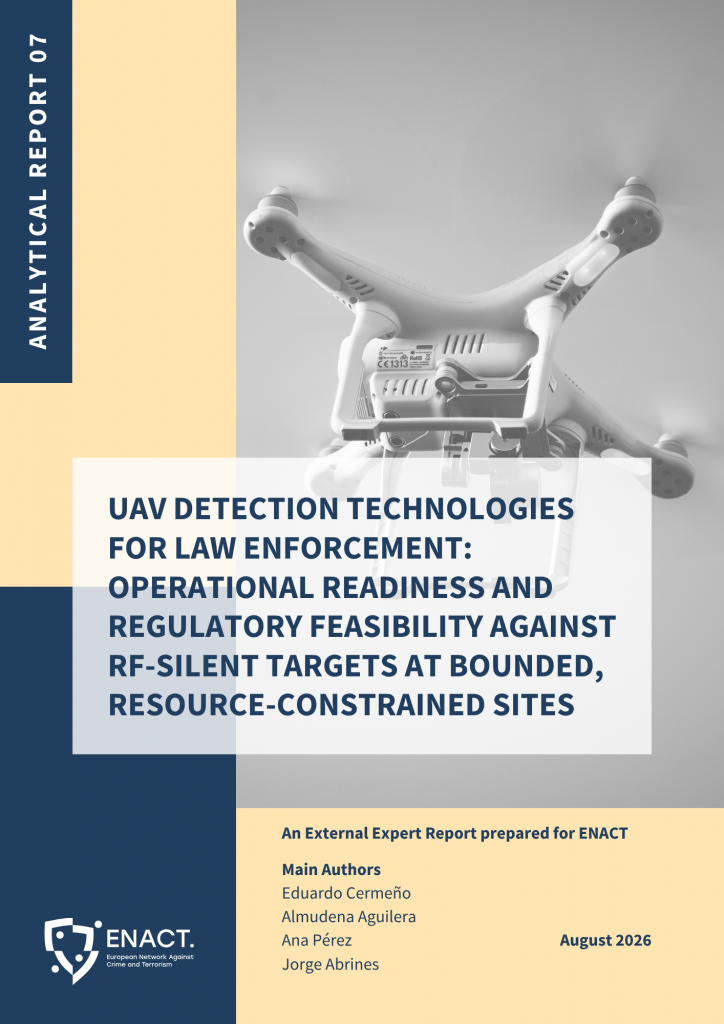
Non-cooperative drone operations are now a routine problem for LEAs at bounded civil-security sites. A growing share falls outside the assumption on which passive radio-frequency (RF) detection rests because it flies pre-programmed GNSS waypoints, is guided by onboard vision, or is controlled through a physical link. RF silence removes one detection route; it does not make the aircraft invisible to radar, EO/IR or acoustic sensing. The operators most exposed to that gap are frequently those least able to close it.
This report asks a narrower question than which modality is superior: what detection capability a budget-constrained operator obtains, over what distance, and where that distance suffices. It is a comparative review of literature, EU law, standards and public deployment evidence completed to 27 July 2026; it conducts no new trials and assesses readiness for defined configurations at defined sites, not for modalities.
Reach is primarily governed by target size. Wingspan-scaling of a related-party field evaluation gives indicative camera-only median detection distances of approximately 32–41 m for a 0.35 m platform, rising to 130–164 m for the 1.42 m object actually measured (Table 10). The source used a non-representative target and cameras tuned for avian detection; the figures bound the pattern indicatively and are not independent validation.
Converted into time, these radii define the capability. At a 40 m visible-band perimeter, a 0.35 m platform transiting at 15 m/s is exposed for under three seconds and a fast FPV platform at 35 m/s for under two. In barrier-coverage terms , such a field delivers weak, probabilistic coverage of constrained approach corridors, not strong coverage of an airspace volume. Fast approach needs a different geometry, based on acoustic nodes in depth; neither its range nor its cost is evidenced here, and characterising both, with thermal, is the principal research recommendation.
On cost, an author-supplied scenario puts the equipment allowance at approximately €16,650–€21,800, or €1,700–€2,200 per node, equipment only (daylight-hours, visible band). They are arithmetic combinations of stated line items, not validated costs, and exclude lifecycle items and the fixed wide-field cameras the pattern requires. The evidential burden differs by site: where the comparator is no capability at all, a deployment must be better than nothing; at designated critical infrastructure, where EU policy calls for multi-sensor architectures, it must demonstrate what it adds.
Three author-defined patterns are distinguished. Autonomous Optical pairs a fixed wide-field camera with an internally cued PTZ and can complete the optical search-to-classification chain unaided. Light Hybrid retains that core and adds only the modality the site’s threat model justifies. Heavy Hybrid integrates radar, passive RF, EO/IR and, where justified, acoustic sensing within a common C2 environment. No pattern is universally optimal; the report recommends comparative trials, configuration-specific acceptance testing and an RF-silent stratum in the CEN Workshop Agreement (CWA) 18150 counter-UAS test methodology before any is relied upon in procurement.
This report was prepared by the External Experts Eduardo Cermeño, Almudena Aguilera, Ana Pérez, and Jorge Abrines
We’re collecting feedback on this report through the EU Survey Platform, if you’d like to share your thoughts please click on the link below.
8th ENACT Analytical Report – Structural Barriers to the Deployment of RF-Based Counter-UAS Systems for Critical Infrastructure Protection in the EU
Read the report: From Lab to Field: Structural Barriers to the Deployment of RF-Based Counter-UAS Systems for Critical Infrastructure Protection in the EU
The European Union faces a growing and asymmetric threat from unmanned aerial vehicles (UAVs) targeting critical infrastructure, public spaces, and defence installations. Commercial drones available for as little as EUR 500 have been used for surveillance, smuggling, and armed attacks, with repeated incursions documented at NATO facilities and civilian airports across Member States. The CER Directive, NIS2, the EU AI Act, and the EASA U-space Regulation create clear obligations for infrastructure operators. The market has not produced commensurate operational solutions.
The EU C-UAS landscape has a growing number of technically validated counter-drone technologies at Technology Readiness Levels (TRL) 3 to 6. Almost none of the EU-developed C-UAS systems have reached sustained operational deployment at scale. The barriers are structural.
The report finds that despite the growth of the counter-drone market, most EU-developed C-UAS systems remain below TRL 7 and have not reached public procurement. RF-based directed energy neutralisation (RF-DEN) has no harmonised legal framework in the EU for non-military actors. Furthermore, no EU-wide C-UAS certification standard exists. Its absence is the main reason infrastructure operators defer procurement, while SMEs face a funding gap between TRL 6 demonstrator and market-ready product that EDF, Horizon Europe, and national defence programmes do not adequately address. evidence from the Iberian ecosystem shows the path from validated proof-of-concept to first public procurement is most often delayed by regulatory aspects, leading to a dead zone in the TRL6 to market transition.
The report closes with five groups of recommendations for EU policymakers, standardisation bodies, public procurement bodies, and the defence innovation ecosystem. Closing the C-UAS TRL-to-deployment gap requires more R&I funding, but also a different process for converting that innovation into operational capability.
This report was prepared by the External Experts Enrique de Nova of Innventuur.
We’re collecting feedback on this report through the EU Survey Platform, if you’d like to share your thoughts please click on the link below.
9th ENACT Analytical Report – Methods to Facilitate the Traceback and Mitigate the Spoofing of Telecommunications
Read the report: Methods to Facilitate the Traceback and Mitigate the Spoofing of Telecommunications
The tracing of communications is used to fight many kinds of crime, but its effectiveness depends on the resources that law enforcement agencies (LEAs) can dedicate to acting upon intelligence supplied by communication providers (CPs). China has extradited many thousands of scammers from overseas call centres despite not asking foreign countries to build new systems to facilitate traceback. The USA’s strategy concentrates on technology, including heavy expenditure on systems that facilitate traceback. However, the resulting number of prosecutions has been modest despite large volumes of scam calls originating on major US networks and a continued rise in the amounts lost by American consumers to scams instigated by a phone call. Europe can draw lessons from the different approaches adopted by China and the USA, including their respective strengths and limitations. In turn, Europe has much to teach the rest of the world about its own successes in tackling scams.
This report looks at a range of different issues and challenges in relation to this spoofing and traceback. Specifically, Chapter 2 will highlight the adaptability of criminals who exploit communications networks and how consumer protection and law enforcement efforts will need to be equally adaptable to keep pace with crime.
Chapter 3 outlines the rival law enforcement philosophies of the two nations exerting most pressure for international coordination of the policing of communications, China and the USA, so we can put European options for tackling networked crime into a global context. Chapter 4 briefly describes the approach taken to gathering information for subsequent chapters.
Chapter 5 provides a summary description of the work being done by the institutions that have the best chance of obtaining the international consensus required for effective international traceback. It should be noted that there is very little coordination of work between these institutions, to the point where they rarely acknowledge each other’s work and may not even be aware of it. This complicates making a fair appraisal of who might ultimately provide international leadership and whose efforts will prove inconsequential.
Chapter 6 evaluates each traceback and anti-spoofing method, with the final chapter making brief recommendations. This will be based on the principles articulated during this introduction, and in particular the assumptions made about the needs of law enforcement agencies operating in the EU. Other potential benefits, such as whether the solutions could also be used to generate new revenues from enhanced telemarketing, will not be considered.
The Annex to the report is available here.
This report was prepared by the External Expert Erik Priezkalns, while the topic of the report was requested by Europol’s European Cybercrime Centre to analyse existing and operational technical solutions to mitigate Caller-ID and Sender-ID spoofing.
We’re collecting feedback on this report through the EU Survey Platform, if you’d like to share your thoughts please click on the link below.
ENACT Analytical Reports
Periodically, ENACT will share expert reports created by our internal experts on key topics surrounding the FCT ecosystem.
1st ENACT Analytical Report – FCT R&I: An analysis of EU priorities 2014 – 2024
Read the report: FCT R&I: An analysis of EU priorities 2014 – 2024

This first ENACT analytical report presents an analytical exercise carried out on the Research and Innovation (R&I) priorities set by the European Commission for the Fight against Crime and Terrorism (FCT) between 2014 and 2024. These priorities have been identified by classifying the focus of 76 FCT research topics and subtopics according to the EU Security Taxonomy developed by the Commission under the EU Security Market Study released in 2021.
The way in which the different taxonomy items appear reflected in the FCT research topics along the 10 years of study show an uneven distribution of priorities along the different areas of interest, both in the policy and in the functions dimensions. In the policy dimension, the analysis shows the emphasis put by the Commission services in the research against Economic crime, corruption and fraud, against the Trafficking of humans and goods and, notably against Illegal markets in the dark web. Regarding the Functions dimension, those which appear among the most frequent research needs are Investigation & Forensics, and Data, information & intelligence gathering management, and exploitation. Finally, in what regards technology, and despite EU-funded security research being mostly non-prescriptive in terms of the typology of technolgies to be employed to address the posed challenges, Internet-based investigation technologies and Data analytics technologies are the most frequently referenced ones.
This analysis constitutes a starting reference base for the work to be carried out by the ENACT network during the coming months and opens the door to answering other research questions that are relevant to support EU policy-makers in the drafting of future FCT R&I priorities.
We’re collecting feedback on this report through the EU Survey Platform, if you’d like to share your thoughts please click on the link below.
2nd ENACT Analytical Report – Security of major public events
Read the report: Security of Major Public Events
This 2nd ENACT Analytical report, compiled by the ENACT consortium for DG HOME, has studied the evidence available within the ENACT Structured Knowledge Base and enriched it with the discussions that took place during the CERIS event on Security of Major Public events organised by the European Commission’s DG HOME on December 2024.
The results of the analysis show that certain threats, capabilities and technology areas might deserve particular attention during future Security R&I programming and implementation.
We’re collecting feedback on this report through the EU Survey Platform, if you’d like to share your thoughts please click on the link below.
3rd ENACT Analytical Report – Internal Security Fund – Analysis of EU Member State Priorities
Read the report: Internal Security Fund: Analysis of EU Member State Priorities
The Internal Security Fund (ISF) is a critical financial instrument that supports EU Member States in preventing and combating serious cross-border crime, cybercrime, and terrorism. The largest share of the fund is dedicated to the National Programmes, which are implemented under a shared management framework between the European Commission and the national authorities of the Member States. Under this framework, Member States are responsible for selecting projects, allocating funding, and managing day-to-day implementation. The priorities in these programmes align well with the security challenges faced by each EU Member State and their capability and capacity-building needs.
Therefore, this report extracts, structures and analyses the Fight against Crime and Terrorism (FCT) priorities articulated within the initial 2021-2027 National ISF Programmes. By extracting planned actions from the official documents and systematically mapping these priorities to the EU Civil Security (EUCS) Market Taxonomy, the findings highlight a dominant policy focus on building threat-agnostic infrastructure, while operationally, Member States heavily prioritise data and intelligence management functions. Technologically, we have a strong, unified consensus on investing in secure data storage and exchange systems.
Ultimately, the analysis reveals a clear strategic shift across the European Union towards intelligence-led policing models, characterised by growing investment in data-centric capabilities, digital infrastructure, and the disruption of organised crime. This direction closely aligns with broader European Research and Innovation (R&I) trends.
We’re collecting feedback on this report through the EU Survey Platform, if you’d like to share your thoughts please click on the link below.
Structured Knowledge Base and Stakeholder Map
ENACT will produce a Stakeholder Map and a Structured Knowledge Base for the FCT domain. Their first versions are available as an explorable dashboard.
ENACT Structured Knowledge Base and Stakeholder Map
FCT Maps from ENACT Observatories
The ENACT observatories will produce periodic reports from their findings based on the ENACT structured knowledge base.
2026 FCT Maps – March 2026 – August 2026
ENACT 2026-2 FCT Maps – Capabilities Observatory
ENACT 2026-2 FCT Maps – Technology Observatory
ENACT 2026-2 FCT Maps – Markets and Standards Observatory
ENACT 2026-2 FCT Maps – Ethical, Legal and Societal Observatory
2026 FCT Maps – September 2025 – February 2026
ENACT 2026-1 FCT Maps – Capabilities Observatory
ENACT 2026-1 FCT Maps – Technology Observatory
ENACT 2026-1 FCT Maps – Markets and Standards Observatory
ENACT 2026-1 FCT Maps – Ethical, Legal and Societal Observatory
2025 FCT Maps – March 2025 – July 2025
ENACT 2025-2 FCT Maps – Capabilities Observatory
ENACT 2025-2 FCT Maps – Technology Observatory
ENACT 2025-2 FCT Maps – Markets and Standards Observatory
ENACT 2025-2 FCT Maps – Ethical, Legal and Societal Observatory
2025 FCT Maps – September 2024 – February 2025
2025 FCT Maps – September 2024 – February 2025
ENACT 2025-1 FCT Maps – Capabilities Observatory
ENACT 2025-1 FCT Maps – Technology Observatory
ENACT 2025-1 FCT Maps – Markets and Standards Observatory
ENACT 2025-1 FCT Maps – Ethical, Legal and Societal Observatory
Annual FCT State of Play Policy Report
Each year ENACT will summarise the outcomes of the Observatories’ work to feed into an annual FCT policy report.
You can provide feedback on the State of Play Policy reports through the feedback link: https://ec.europa.eu/eusurvey/runner/enact-report-feedback
ENACT 2025 FCT State of Play Policy Report
ENACT 2024 FCT State of Play Policy Report
Deliverables
ENACT public deliverables are shared below after they have been approved through the EC expert review process, while public summaries are shared for all other deliverables.
D1.1 Project Management Plan (SUMMARY)
The document “D1.1 Project Management Plan” (PMP) sets out the organisational, communication, quality assurance, and risk management framework for the European Network Against Crime and Terrorism (ENACT) project.
ENACT aims to provide evidence-based support to EU Research & Innovation (R&I) decision-makers for more effective and efficient programming in the Fight against Crime and Terrorism (FCT) domain. To achieve this, the project brings together a multidisciplinary consortium and a clear management structure to coordinate activities, ensure timely delivery of outputs, and maintain high-quality standards.
The PMP describes the internal and external communication strategies, quality assurance guidelines, deliverable review processes, financial reporting procedures, and a proactive risk management plan to address potential challenges.
Ethical and legal considerations were assessed in the preparation of this plan. While no major issues were identified at this stage, the consortium adopted measures to safeguard sensitive information and ensure compliance with EU regulations on confidentiality, ethics, and data protection. These include strict internal protocols, controlled access to sensitive deliverables, and adherence to the European Commission’s ethics guidelines.
D1.2 Data Management Plan (SUMMARY)
The document “D1.2 Data Management Plan” (DMP) provides a comprehensive overview of how data will be managed throughout the European Network Against Crime and Terrorism (ENACT) project. ENACT, a Coordination and Support Action, began on September 1, 2023, and will run for 36 months.
ENACT aims to provide evidence-based support to EU Research & Innovation (R&I) decision-makers for more effective and efficient programming in the Fight against Crime and Terrorism (FCT) domain. To achieve this, the project will create a structured and updated landscape of FCT dynamics and trends by scrutinizing information from various sources. This process involves a structured approach to research data usage, balancing the needs of all actors.
ENACT’s DMP is built upon the FAIR Principles: Findable, Accessible, Interoperable, and Reusable for digital assets. The ENACT project places a central emphasis on legal compliance and ethical considerations.
The project will ensure compliance with relevant regulations, including the General Data Protection Regulation (GDPR), the Data Governance Act (DGA), and the Artificial Intelligence (AI) Act.
D1.3 Ethical and Legal Analysis Report (PUBLIC)
This Deliverable, D1.3 “Ethical and Legal Analysis Report”, is the result of the work already developed within T1.4 “Ethical Management & Legal Analysis”. The tasks goals are twofold. First, the task will identify the relevant legal and ethical frameworks to be considered in the project’s activities and duration, with focus on human rights, data protection, cybersecurity and data management. Mapping the relevant framework is essential to establish good practices and to identify attention points for all the partners of the projects. Second, the results of this analysis will allow the identification of the effects, negative and positive, of the project into society. Reflecting upon possible risks, it will be possible to create and test mitigation measures to guarantee that ENACT’s results are compliant by-design and by-default.
D1.3 will present the methodology adopted in the assessment of legal and ethical requirements. ENACT, then, will follow the Responsible Research and Innovation (RRI) approach1, which will allow a continuous and effective implementation of mitigation measures in parallel with a comprehensive analysis of the risks of the project, via engagement with different stakeholders. Following, the Deliverable will present an initial assessment of which human rights might be interfered by the project activities. As a knowledge hub, ENACT will handle different datasets. Thus, this report also presents the initial analysis of the relevant framework for data management to be considered by ENACT partners, evaluating the differences between personal and non-personal data. Finally, the report also will establish an introduction to cybersecurity aspects that shall be applied and considered in the design of ENACT’s products.
As the evaluation of risks and benefits of a product is a continuous activity, this Deliverable should be understood as the inaugural assessment of the relevant ethical and legal frameworks. The results here presented will be updated in the following cycles of the project.
Read the deliverable: D1.3 Ethical and Legal Analysis Report
D1.4 Report on Financial Support to Third Parties (PUBLIC)
This report establishes the framework for Financial Support to Third Parties (FSTP) within ENACT, aimed at enhancing European security through collaboration with external stakeholders, including industry, academia, and other innovators. ENACT dedicates 25% of its total budget, amounting to 552,500.00 €, specifically to engage with both providers and users of innovative solutions for validating, developing, and disseminating Fighting Crime and Terrorism (FCT) Research and Innovation (R&I) results.
The report details the mechanisms for managing financial support and cooperation, including the engagement with the winners of the Security Innovation Awards, creation of calls for validation with Law Enforcement Agencies (LEAs) and end-users, organisation and participation in FCT R&I events, and the commission of in-depth studies by external experts. These initiatives aim to boost the visibility, credibility, and adoption of innovative solutions, driving competitiveness and maximizing the impact of ENACT and other FCT R&I projects. All activities are governed by a legal framework that ensures compliance with public procurement rules, transparency, and ethical standards, ensuring fairness throughout the process.
Read the deliverable: D1.4 Report on Financial Support to Third Parties
D4.1 ENACT Methods and Tools v1 (PUBLIC)
This deliverable presents the RESEARCH tools and the NETWORKING tools set-up by the ENACT project which will be further developed during the implementation cycles. The work of this deliverable has been carried out under the tasks T4.1 and T4.2.
The ENACT RESEARCH pillar will set-up an Observatory system that will count with a Capability Observatory, a Technology Observatory, a Market, funding & Standardisation Observatory and an Ethical, Legal & Societal Observatory. In addition to these four knowledge areas, a fifth observatory, the so-called Inter-Observatory Coordinator (IOC), will merge the knowledge delivered by the others and deliver it in a common FCT R&I knowledge picture.
Each of the observatories has been defined to set the boundaries of their respective fields of interest. These fields of interest include, among others, fight against crime and terrorism (FCT) policy priorities, security threats and security functions (CapO), main science and technology trends, R&I outcomes and Commercial Off-the-shelve (COTS) products (TechO), tender opportunities, industrial fairs and exhibitions and standardisation (MFS), and ethical, legal and societal aspects to guarantee the development of initiatives and creation of knowledge ethically and legally based (ELSO). The leadership, contributors and functioning of the observatories have also been defined, establishing a process of planning, operation and reporting that will be executed during each implementation cycle foreseen in the project. During such implementation cycles, the observatories will produce various ENACT products, including the FCT Maps, Flash reports, Advanced Analytical Reports and Annual State of Play FCT Policy Reports. The scope and main aspects to be considered in the elaboration of these products have been defined in this strategy in order to facilitate their release, notably during the test implementation cycle. Among the main tools to be used by the observatories to carry out their work, the following have been included: The EU Security taxonomy, the ENACT Structured Knowledge Base (SKB), and a set of online data acquisition tools. The latest will be mainly used to retrieve information from the main data sources identified in this strategy as a starting point.
The ENACT NETWORKING pillar will display the tools needed to articulate the network, namely the ENACT Stakeholder Map, the Stakeholder register and the ENACT NETWORKING Logfile.
The Stakeholder map visualizes all ENACT communities of interest and the 3 main target groups of stakeholders (Knowledge Hubs, relevant organisations and experts). In the Stakeholder register, all stakeholders will be registered including the Point of Contact (PoC) from the ENACT consortium and from the Stakeholder organisation. Finally the ENACT NETWORKING logfile will log all registered interactions, connections and related communications and exchanged knowledge so that the project can monitor the progress and the compliance to the KPIs for the NETWORKING pillar. During the upcoming 3 implementation cycles the Stakeholder map, the tools and the (internal) procedures and responsibilities will be monitored, evaluated and updated if needed.
Read the deliverable: D4.1 ENACT Methods and Tools v1
D4.2 ENACT CDE & Cooperation Plan (SUMMARY)
This deliverable sets out the strategy and processes for the set-up of the Communication, Dissemination and Exploitation (CDE) Tools and the set-up of the Cooperation Tools of the ENACT project. The CDE and Cooperation Pillars of ENACT are set up as part of the initial set-up phase of the project. The two other pillars, Networking and Research, are similarly described in D4.1 ENACT Network Methods & Tools v1 .
The CDE set-up is divided into two streams of work, the first is related to the development of the visibility and design materials that can be used throughout the project, while the second is focused on the development of the CDE plan and strategy for the remainder of the project. The implementation of the CDE plan will be carried out under WP8, WP9 and WP10 Amplification Actions.
For the visibility and design materials the deliverable describes the development of the project logo, colour scheme, iconography, diagrams and document/presentation templates. Furthermore, initial versions of the offline materials such as the banner, leaflet and poster and report templates are described. Similarly, this also encapsulated the set up of the website and social media streams and the preparatory action for the development of the ENACT introductory video.
The communication and dissemination strategy describes the ENACT stakeholder identification and mapping (as initially described in the networking pillar), as well as the key messages and channels ENACT will use to reach different audiences. A key output for ENACT will be the development of the knowledge repository that will house the findings of the ENACT observatories. Further processes for targeting various dissemination opportunities and the related KPIs and metrics are also described.
The final section of the deliverable focuses on the Cooperation Pillar and specifically the ENACT external cooperation strategy. The process for implementing the four key activities of the Cooperation Pillar are described. Namely, the validation of Fight against Crime and Terrorism (FCT) research results, the commission of in-depth studies by external experts, the support for the winners of the security innovation awards, and actions to support and organise FCT Research and Innovation (R&I) events.
D5.1 ENACT Network Methods & Tools v2 (SUMMARY)
The ENACT Work Package (WP) 5 focuses on the test implementation cycle, where the strategies developed in WP4 are put into practice to refine the plan and identify areas for improvement. WP5 also addresses key challenges encountered during this phase, offering solutions and providing guidelines and recommendations to support future work packages and similar initiatives.
The D5.1, one of three WP5 deliverables, outlines the strategies, planning processes, resources, challenges, solutions and recommendations implemented during this phase, including both technological and methodological aspects. This deliverable has been developed under tasks (T) T5.1, T5.2, T5.3, and T5.4 and pays special attention to the ethical and legal implications of ENACT’s approach.
During the WP5 progress, the observatory system (Research pillar) served as the foundation for data collection, analysis, and characterization. The deliverable further details the tools and methodologies utilized by the observatories, such as the European Union Civil Security (EUCS) Taxonomy, the ENACT Structured Knowledge Base (SKB), and various online data acquisition tools. Meanwhile, the Networking Platform (Networking pillar) established ENACT as a functional hub that facilitates collaboration and engagement with stakeholders, knowledge hubs (KHs), and the broader fight against crime and Terrorism (FCT) research and innovation (R&I) community.
The observations analysed under WP5 primarily cover the period from 2014 onwards, aligning with major developments in the EU’s FCT R&I landscape. Data were sourced from public databases, policy papers, scientific literature, practitioner reports, news media, and consultation results, enabling the observatories to capture key trends, priorities, and challenges relevant to FCT policy and practice.
The tools, solutions, and guidelines outlined in D5.1 and equivalent tasks enabled the observatories to produce critical ENACT products, including FCT Maps, Flash Reports, Advanced Analytical Reports, and the Annual State of Play (SoP) FCT Policy Reports, all of which are presented in D5.2. Each report undergoes an ethical and legal screening, and although the SKB is targeted to be publicly accessible, sensitive findings are shared only with authorised audiences through controlled dissemination.
WP5 successfully addressed several challenges, including data collection hurdles, technical issues, stakeholder engagement difficulties, and the need to comply with data-protection and ethical requirements, ensuring the project remained on track to meet its objectives.
The lessons learned during this cycle have been instrumental in shaping strategies for the upcoming full implementation cycles (WP6 and WP7), setting the stage for further progress and refinement of the ENACT framework.
D5.2 ENACT Network Activity Report v1 (SUMMARY)
This deliverable presents the results of the ENACT Network Activity Report. It compiles the first batch of network outputs across four key pillars, summarising all findings, outcomes, and recommendations. The efforts are based on the strategies, methodologies, processes and tools outlined in deliverables D4.1, D4.2, and D5.1, focusing on systematically collecting, characterising, and validating observations, while mapping stakeholders to prepare several ENACT products.
By the end of this test cycle, a first iteration of all Network outputs in the 4 Pillars, corresponding to the identified KER (KER1 to KER5) are at the disposal of the stakeholders for their evaluation and use for decision making. One of these products, the Stakeholder Map (KER1), connects ENACT with major, pre-existing European Union (EU) fight against crime and terrorism (FCT) research and innovation (R&I) Knowledge Hubs (KHs) and organisations pivotal to the FCT community. In the first version of the Stakeholder Map, ENACT identified and registered 1013 stakeholders, primarily from Europe, representing various communities within the FCT ecosystem. This number is expected to grow substantially as the project progresses, driven by systematic identification and monitoring efforts, as well as active engagement in key events, particularly those focused on technology and security sectors.
We also successfully created a comprehensive Periodic FCT map (KER2), which consolidates data from all four observatories, providing a comprehensive summary of the information collected over six months by the observatories. The FCT map compiles a total of 671 observations drawn from a wide array of sources and covering the period from 2014 onwards, aligning with major developments in the EU’s FCT R&I landscape and enabling the observatories to capture key trends, priorities, and challenges relevant to FCT policy and practice. Additionally, we produced two Flash Knowledge Reports (KER3), which provide quick, on-demand insights focused on specific drivers such as policies, threats, functions, or technologies, and an Analytical Reports (KER4) prepared by the Consortium, offering detailed examinations of specific topics. Currently, we are finalising three more flash reports and the Annual State-of-Play (SoP) FCT Policy Report (KER5), with a concise overview of recent developments, insights, and recommendations from various ENACT activities. These outputs are set to be presented at the ENACT Annual Event 2024, which will be held in Lisbon on September 20th.
The evaluation by the FCT community reflects positively on the ENACT products, with feedback highlighting the effectiveness and relevance of these efforts.
After this test cycle, two full implementation cycles of 12 months each will follow in WP6 and WP7, where the strategies, methods, processes and tools improved and gathered will be bundled every six months at the request of the EC and reported in subsequent annual Network Activity Reports and ENACT Annual Reports. As done during the test implementation cycle, feedback from the stakeholders on the quality, usefulness and timeliness of the delivered products will continue to be gathered. Based on the feedback received, the methods, processes and tools employed will be adapted as needed in order to maximise the relevance of ENACT outcomes.
D5.3 ENACT Annual Report v1 (PUBLIC)
ENACT is a knowledge network dedicated to fighting crime and terrorism (FCT), with the mission to collect, aggregate, process, and disseminate valuable insights in the FCT domain. The ENACT network is built upon four key pillars: Networking, Research, Communication, Dissemination and Exploration (CDE), and Cooperation. In its first year, ENACT established and tested the strategies, methods, tools, and processes essential to each of these pillars, ensuring the effective operation of the Knowledge Network.
ENACT has implemented an Observatory system to extract, classify, and visualise information from the community through Knowledge Hubs (KHs), ultimately providing valuable feedback to stakeholders. The Observatory system consists of four main Knowledge Observatories (KOs), which cover the following domains of interest: i) Capabilities; ii) Technology; iii) Market, funding & standardisation (MFS); iv) Ethical, Legal & Societal (ELS). In addition to these four knowledge areas, a fifth observatory, the Inter-Observatory Coordinator (IOC), merges the knowledge delivered by the other Observatories and presents it as a comprehensive FCT research and innovation (R&I) knowledge picture.
The first ENACT Annual Report marks the project’s inaugural year, sharing disclosable information about its network’s activities and outcomes. This report highlights the ENACT products created to facilitate the exchange of knowledge and value across the broader FCT community. It is at the disposal of the stakeholders for their evaluation and use for decision making. One of these products, the Stakeholder Map (key exploitable result KER1), connects ENACT with major, pre-existing European Union (EU) FCT R&IKHs and organisations pivotal to the FCT community. In the first version of the Stakeholder Map, ENACT identified and registered 1013 stakeholders, primarily from Europe, representing various communities within the FCT ecosystem. This number is expected to grow substantially as the project progresses, driven by systematic identification and monitoring efforts, as well as active engagement in key events, particularly those focused on technology and security sectors.
ENACT also successfully created a comprehensive Periodic FCT map (KER2), which consolidates data from all four observatories, providing a comprehensive summary of the information collected over six months by the observatories. The FCT map compiles a total of 671 observations drawn from a wide array of sources and covering the period from 2014 onwards, aligning with major developments in the EU’s FCT R&I landscape and enabling the observatories to capture key trends, priorities, and challenges relevant to FCT policy and practice. Additionally, ENACT produced two Flash Knowledge Reports (KER3), which provide quick, on-demand insights focused on specific drivers such as policies, threats, functions, or technologies, and one Analytical Reports (KER4) prepared by the Consortium, offering detailed examinations of specific topics. Currently, ENACT is finalising three more flash reports and the Annual State-of-Play (SoP) FCT Policy Report (KER5), with a concise overview of recent developments, insights, and recommendations from various ENACT activities. These outputs are set to be presented at the ENACT Annual Event 2024, which will be held in Lisbon on September 20th.
The evaluation by the FCT community reflects positively on the ENACT products, with feedback highlighting the effectiveness and relevance of these efforts. After this first version, the subsequent ENACT Annual Reports will be presented yearly. ENACT outcomes will be adapted based on the feedback received to maximise their relevance and contributions to the FCT community.
Read the deliverable: D5.3 ENACT Annual Report v1
D8.1 Impact Report v1 (SUMMARY)
This deliverable (D) describes the communication and dissemination activities made in the context of ENACT between months (M) 1 and 12 of the project. This is the first of three deliverables that will report on the communication, dissemination and impact of project activities at 12-month intervals.
Starting the document, the first two sections are introductory and set the scene of the ENACT project. The core of the deliverable describes the main CDE actions and evaluates their performance and impact during the previous 12 months (from September 2023 to August 2024). Throughout the project, ENACT has maintained a healthy online presence through regular news items and upcoming events on the events calendar. This has resulted in substantial visits to the ENACT project website and interactions through the ENACT LinkedIn social media channel.
Additionally, ENACT has attended multiple exhibitions, conferences, and events, written dedicated reports, and launched its first official project newsletter. The culmination of the first 12 months was celebrated at the first ENACT annual event in September, bringing together a wide range of stakeholders from across the FCT community.
The fourth section lays the groundwork to define a set of innovation uptake and exploitation pathways for the ENACT results, whilst also providing an overview of relevant ENACT results and the potential for their uptake, including the methodology and models.
The last section describes the external cooperation activities that will contribute to ENACT’s success. This includes the projects chosen for the Security Innovation Awards, the validation of FCT R&I results and the development of the in-depth studies by external experts.
Scientific and Mainstream Publications
Scientific Publications
RISE-SD Proceedings – ENACT: European Network Against Crime and Terrorism
Alegria, A., Gibson, H., De Tommaso, M., Tsatsou, D., Kosmatopoulos, A., Brumter, G., Cunha, I., Rosal, I. M., Piotrowicz, C., Carbayo, R., van de Crommert, P., Puustinen, J., & Ríos Morentin, D. (2024). ENACT: European network against crime and terrorism. In RISE-SD 2024 Online Proceedings (p. 59).
Read the publication
(Global) single market for data? Exploring data cosmopolitanism as a solidarity-based regulatory approach to the European health data space
Musidlowska, M., Fierens, M., & Rosal, I. M. (2026). (Global) single market for data? Exploring data cosmopolitanism as a solidarity-based regulatory approach to the European health data space. Data in Brief, 113016.
Read the publication
From Innovation to Market
Alegria, A., Bianchi, S., Fernandes, N., Germini, A. M., Salvi, O., Wieden, K., Klonk, J.& Manso, M. (2026). “From Innovation to Market” White Paper. Zenodo. Security Mission Information & Innovation Group (SMI2G) event (SMI2G), Paris. https://doi.org/10.5281/zenodo.21804934
Read the publication
Policy Papers
National Innovation Report 2024: Security and Defence Edition (Portugal)
Agência Nacional de Inovação. (2025). National Innovation Report 2024: Security and defence edition.
Read the report
Operational challenges in digital security: Joint takeaways from the LEA projects cluster
Privanova. (2026). Operational challenges in digital security: Joint takeaways from the LEA projects cluster.
Read the report
LinkedIn Articles
From Knowledge to Action: Tackling Fragmentation and Driving Security Innovation in the EU
Alegria, A., Rodrigues, F., & Morentin, D. R. (2024, November 12). From knowledge to action: Tackling fragmentation and driving security innovation in the EU. LinkedIn.
Read the article
Who is Who? Navigating Stakeholders in the Ecosystem of EU-funded FCT R&I Projects
Morentin, D. R. (2026, April 24). Who is who?: Navigating the stakeholders ecosystem of EU-funded FCT R&I. LinkedIn.
Read the article
ENACT in the Media
Knowledge network helping in the fight against crime and terrorism
CORDIS. (2023, August 10). Knowledge network helping in the fight against crime and terrorism. European Commission.
Read the article
Luísa Proença: ‘Sharing best practice with other law enforcement agencies fosters collaboration and improvement’
Staniforth, A. (2024, June 11). Luísa Proença: ‘Sharing best practice with other law enforcement agencies fosters collaboration and improvement’. Policing Insight.
Read the interview
Police innovation: Engaging with EU research to fight crime and terrorism
Staniforth, A. (2026, March 25). Police innovation: Engaging with EU research to fight crime and terrorism. Policing Insight.
Read the article
ENACT Project Supports Security Innovation Award Winners in their Advance on Innovation in the Fight Against Crime and Terrorism
European Network Against Crime and Terrorism. (2024, December). ENACT Project Supports Security Innovation Award Winners in their Advance on Innovation in the Fight Against Crime and Terrorism [Press release].
Read the press release
PJ acolhe o evento anual do projeto ENACT e promove cooperação europeia
Polícia Judiciária. (2025, December 19). PJ acolhe o evento anual do projeto ENACT e promove cooperação europeia [PJ hosts the annual ENACT project event and promotes European cooperation].
Read the article
Trending Topics in the fight against crime and terrorism community
Santos, I. R. (2024, November 5). Trending topics in the fight against crime and terrorism community. CiTiP Blog.
Read the article
Cooperação europeia em destaque no ENACT Annual Event promovido pela PJ
Beira Digital TV. (2025, December 19). Cooperação europeia em destaque no ENACT Annual Event promovido pela PJ [European cooperation highlighted at the ENACT Annual Event promoted by the PJ].
Read the article
PJ acolhe o evento anual do projeto ENACT
Central Press. (2025, December 19). PJ acolhe o evento anual do projeto ENACT [PJ hosts the annual ENACT project event].
Read the article
Solutions Supported by the Cooperation Pillar
Through the Cooperation Pillar, ENACT is supporting winners and runners-up of the Security Innovation Awards and Europol’s Excellence Awards in Innovation. Find below a summary of the projects that have made information publicly available on how ENACT’s funding has enhanced their solution.
AinoAid (We Encourage) – AI-Powered Early Intervention and Victim Support for Safer Communities
DrugHunter (SafePAS) – Bringing Laboratory-Accurate Drug Analysis to the Roadside
CRIMSON – Smart operation management for collaborative command and control
REVION – Rehabilitation, Violence, Neurodivergent
Pathways to Market Reports
Pathways to Market Reports will be prepared and delivered at each cycle of the project.
1st ENACT Pathways to Market Report – July 2025
Read the report: Pathways to Market Report – July 2025
The ENACT Pathways to Market (PtM) report serves as a comprehensive framework designed to support Fighting Crime & Terrorism (FCT) Research & Innovation (R&I) projects in their journey from validation to market implementation.
This report outlines the methodology and processes developed to assist projects in identifying viable commercialisation routes and enhance their market potential. The PtM reports represent a crucial component of ENACT’s validation facility, implemented under the Task (T)8.3/Task 9.3/Task 10.3 “External Cooperation Activities” throughout the project’s cycles. The PtM reports evaluate the validation facility and provide actionable recommendations for market uptake and exploitation.
We’re collecting feedback on this report through the EU Survey Platform, if you’d like to share your thoughts please click on the link below.
2nd ENACT Pathways to Market Report – April 2026
Read the report: Pathways to Market Report 2 – April 2026
The ENACT Pathways to Market (PtM) report serves as a comprehensive framework designed to support Fighting Crime & Terrorism (FCT) Research & Innovation (R&I) projects in their journey from validation to market implementation.
This report provides an update on the PtM following the nine projects that were included in the Validation Facility as part of the ENACT Annual Event in December 2025. The report provides a brief overview of each project and the recommendations for future exploitation and uptake. These are summarised as a set of available uptake instruments that are there to support projects and innovative solutions make the next step in their uptake journey.
We’re collecting feedback on this report through the EU Survey Platform, if you’d like to share your thoughts please click on the link below.
3rd ENACT Pathways to Market Report – September 2026
Read the report: Pathways to Market Report 3 – September 2026
The ENACT Pathways to Market (PtM) report serves as a comprehensive framework designed to support Fighting Crime & Terrorism (FCT) Research & Innovation (R&I) projects in their journey from validation to market implementation.
This report provides an update on the PtM following the three projects that were included in the Validation Facility as part of the ENACT Annual Event in July 2026. The report provides a brief overview of each project and the recommendations for future exploitation and uptake. These are summarised as a set of available uptake instruments to support projects and innovative solutions in the next step of their uptake journey, as well as a broader look at mechanisms to go beyond TRL 9.
We’re collecting feedback on this report through the EU Survey Platform, if you’d like to share your thoughts please click on the link below.